How to Automate Refi Monitoring for Independent Mortgage Brokers
Independent brokers lose refis to retail lenders with always-on rate technology. Here's how AI automation closes the gap—on the data and tools you already use.
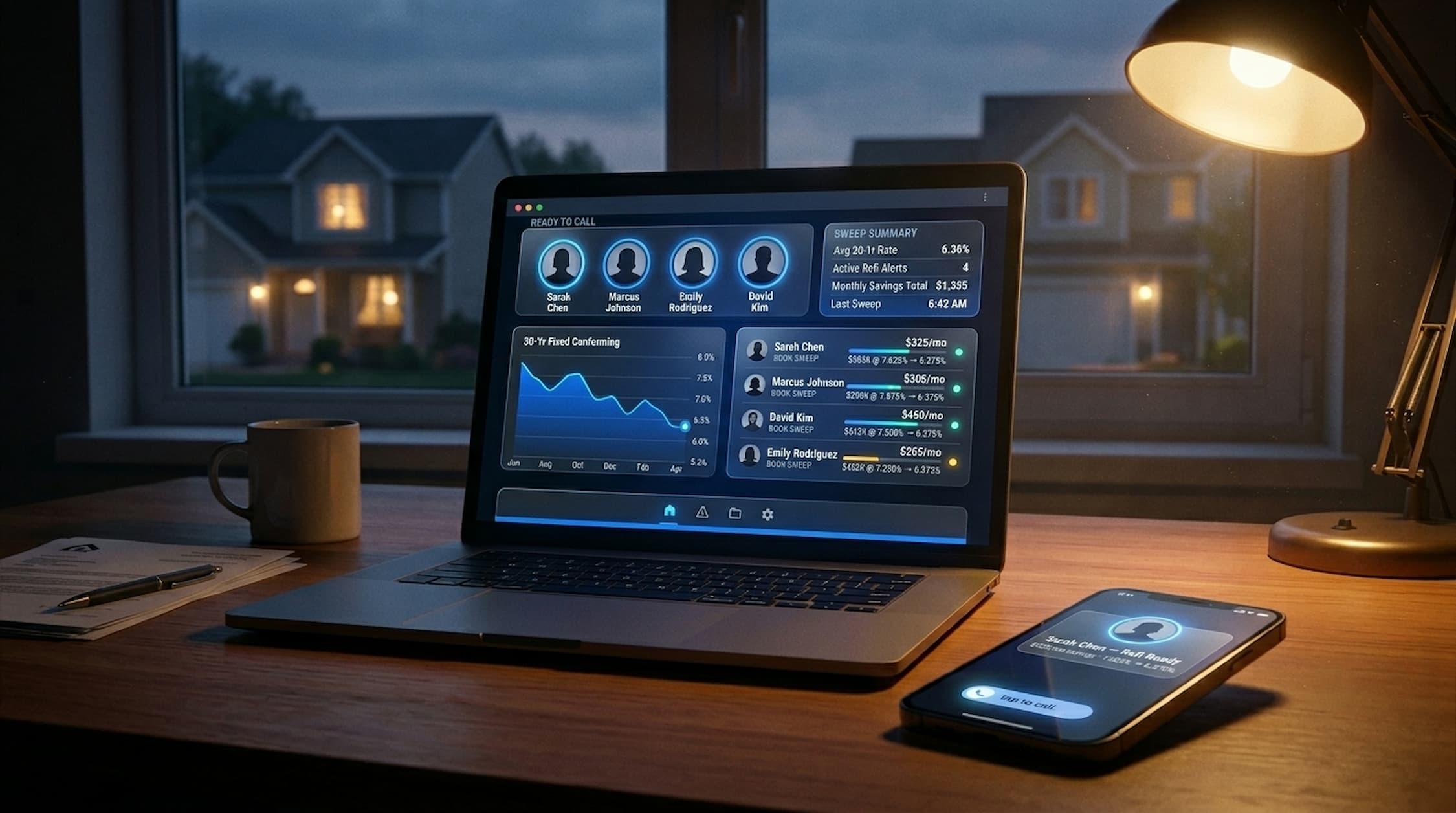
We build AI-powered systems that monitor rates daily, sweep your closed-loan book the moment the math moves, and surface refi-eligible borrowers by name—on the CRM and tools you already use. No new platform to learn. No retail-lender tech to outrun.
The borrower you closed 3 years ago doesn't get an email from your shop the morning of a rate drop. They get one from Rocket—publicly reporting an 83% refinance recapture rate, roughly three times the broader market's recent 25–28% range (Rocket Companies, March 31, 2025; Mortgage Professional America, April 2026). From UWM partners running automated outreach systems that call 50 past clients in 3 minutes the moment rates move (National Mortgage Professional, 2026). Your relationship is real. Theirs is faster. Which means by the time you sweep your pipeline Friday, the call has already happened.
A weekly sweep of a 500-borrower book takes most of a Monday. Even diligently done, it misses 4 business days of fresh signal between sweeps. Industry refinance recapture sits at roughly 25–28% (Mortgage Professional America, April 2026; Rocket Companies, March 31, 2025; Axios, March 31, 2025). Which means roughly 3 in 4 refinance opportunities go to other lenders or servicers before the original broker can act.
A broker-savvy ops hire who understands pricing, knows your CRM, and can build the math behind a refi sweep is the same person every lender in your market is recruiting. Even when you find them, you're paying $75K–$120K to build something a system handles in 2–4 weeks. Which means the headcount question is the wrong question—the system you'd hire them to build is the thing you actually need.
Your pipeline doesn't have to run on memory and luck.
See How We Fix This ↓Refi monitoring is hours of weekly work for an independent broker—rate-sheet sweeps, daily portfolio checks, threshold math. An AI-powered system can run it continuously, on the data and tools you already use. You keep your CRM, your lender pricing engine, and the borrower relationships you've built. The Refi-Alert product line adds the daily watch and the ranked call list on top of all of it.
Want to see how this works?
On every Refi-Alert build, the architectural commitment is the same:
AMA's Refi-Alert product line is built human-in-the-loop by design—not a toggle, no autopilot mode. The system identifies opportunities in your closed-loan book and surfaces them to you; all outreach—to anyone on your client roster—stays under your control. This is a deliberate architectural choice—you keep relationship judgment, compliance posture, and timing in your own hands while the system handles the watching.
Automated rate monitoring and threshold-gated pipeline sweeps run themselves—on the same data and CRM you already use. Per-borrower rate checks complete in roughly a second; a 50-borrower sweep finishes in minutes, not hours. Which means the Monday morning you used to spend sweeping rate sheets becomes a Monday morning spent closing the borrowers the system flagged for you.
The monitoring runs every business morning—threshold-gated, so it only fires when rates have moved enough to matter. The watchlist never drops a name; the system holds every closed-loan borrower in scope until you remove them. Which means the borrower who slipped through the cracks last quarter has someone watching the file this quarter—even when your week is buried.
The same architecture that monitors 200 past borrowers runs fine for 2,000. (Larger books are scoped at engagement entry.) The cost doesn't scale linearly with borrower count, and neither does the time you spend running it. The system sweeps only the borrowers whose timing is in or approaching refi range, so cost and effort track active opportunity instead of total book size. Which means growing the book stops requiring a parallel investment in headcount, training, and turnover risk—and starts looking like turning up the volume on a system that's already running.
Three steps from scoping which refi-alert version fits your book to a self-running monitoring layer—built against your existing CRM and closed-loan book, deployed in 2–4 weeks.
We scope the refi-alert build against your actual book—closed-loan history, CRM, and rate-source preference. You leave the call with the variant that fits (Core, Standard, or Elite), the integration plan, and a build timeline.
We build the system against your existing data—your CRM, your closed-loan book, and your rate source (a daily market rate index for direction, your lender pricing engine for the per-borrower rate lookup that drives the daily Red / Yellow / Green classification). A scoped refi-alert build typically deploys in 2–4 weeks. No rip-and-replace, no new platform to learn.
Every build includes post-deployment monitoring and tuning against real borrower data—window is tier-scoped, confirmed at engagement entry. The system gets sharper week over week, and you keep the relationship with every borrower.
The retail-lender advantage isn't skill. It's architecture.
A retail lender's tech stack monitors market rates around the clock. When the day's rate movement crosses a threshold, the system sweeps the borrower book, flags borrowers in seasoning range, and triggers outreach—often automated calls or emails—within minutes of the rate moving. UWM's Mia calls 50 past clients in 3 minutes the moment its rate-drop algorithm fires (National Mortgage Professional, 2026).
Rocket Mortgage publicly reports an 83% refinance recapture rate—roughly three times the broader market's recent 25–28% range (Rocket Companies, March 31, 2025; Mortgage Professional America, April 2026). That gap isn't a function of better brokers. It's a function of always-on monitoring matched with always-on outreach.
What independent brokers have that retail lenders don't is the relationship—the trust, the history, the actual judgment a borrower wants in a refi conversation. What they don't have, until they build it, is the layer that watches the rates and surfaces the names. AI automation closes that gap on your data, your CRM, your borrower list—not on a retail-lender platform you don't own.
Which means the only thing standing between your relationships and the refi recapture rate they deserve is the system you haven't built yet.
Every business morning, before you open your inbox, the system runs the daily scan: a single market-rate poll, gated to fire only when the day's market move clears your threshold. When it does, the system pulls your CRM client list, runs the per-borrower rate lookup, tags borrowers Red, Yellow, or Green, and sends you a summary email or SMS—no third-party rate-platform login required. You decide who to call. Which means the Monday-morning rate-sweep ritual stops being your job.
Standard adds intraday polling to the Core daily scan. The system checks rates during market hours—every 30 to 60 minutes—so a borrower who moves into refi range at 10:14 a.m. shows up on your list by 10:30, not the next morning. Tier thresholds are configurable per client; tool integrations cover a broader stack. Which means you catch the opportunity that moves during the trading day, not just the one that surfaces overnight.
Elite solves the lender-divergence problem. The market-rate gate watches the national-aggregate signal; Elite layers on daily Base Pricing polls of your top investors with a weekly full-scan across your lender panel. When one lender's pricing diverges from the index, you see it the morning it happens—not after a borrower has already heard from somewhere else. Deep CRM integration ties the divergence signal back to the affected borrowers by name. Which means you catch the refi the national-aggregate gate misses.
Tell us about your pipeline, your CRM, and the part of the week you'd most like back—we'll show you what fits.
Three things: your closed-loan list (borrower contact info plus loan terms—rate, amount, date, term, type), access to whatever system that data lives in, and your break-even logic (which rate drop triggers a real opportunity for your client). Most brokers have all three already; consolidating scattered closed-loan data into one place the system can read is part of the build, not a prerequisite.
Edge cases—atypical loan profile, conflicting rate signals, missing CRM data—surface for your manual review instead of getting auto-classified. The system flags the gap and hands you the file. You decide what the call is.
A scoped automated refi-monitoring build typically deploys in 2–4 weeks once credentials are in place. The variables that move that timeline are portfolio size, where your borrower data currently lives (some integrations are direct; others are scoped for feasibility at engagement entry), which variant fits your book (Core, Standard, or Elite), and your notification preferences. Build, deploy, monitoring, and tuning are handled end-to-end—technical skill on your part is not required.
Works with your existing CRM. Direct integrations cover major platforms; others are scoped for feasibility at engagement entry. Older or paper-based systems may need a one-time import. The integration approach changes; the architecture and build cadence don't.
A 30-minute conversation about your current pipeline sweep, recapture process, and rate-monitoring practice. We'll surface where refi revenue may be leaking—missed signal, slow follow-up, no sweep cadence at all—and discuss rough revenue impact based on your portfolio size and average loan value. No pitch, no obligation. You walk away with a clear picture of where the gaps are and what addressing them could look like.
The system that closes the speed gap with retail lenders is the same system that gives back the hours you'd rather spend originating, not chasing. The discovery call walks through your pipeline, your CRM, and your most-bled hours—and shows you what's worth automating first.
Book a Refi-Discovery CallOnce you book, you'll get a confirmation email with a calendar invite and a short pre-call worksheet covering your portfolio size, current CRM, and the top 3 time-bleed workflows in your week. On the call—30 minutes—we walk through what's eating the hours, what the highest-ROI automations look like for your shop, and what a scoped build would actually cost. No pitch. No obligation. If the math doesn't work, we'll tell you.
Free 30-minute call · No commitment · No sales pitch.
Built to Deliver
End-to-end delivery. No platform to learn.
We build, deploy, and tune the system on your data, CRM, and lender panel.
You're running on the system before most agencies finish discovery.
SOC 2 Type II + AES-256. LO-grade data security.
Built on a SOC 2 Type II certified platform, with AES-256 encryption at rest and TLS 1.2+ in transit.
The same posture lenders expect from their core systems.
Broker-vocabulary, broker-workflow, broker-pricing—not generic SMB.
Our published broker writing covers refi monitoring architecture, market-rate integration, retail-lender competition, and sweep-cadence economics. Built for brokers, not adapted from a different vertical.