How to Automate Refi Monitoring for Independent Mortgage Brokers
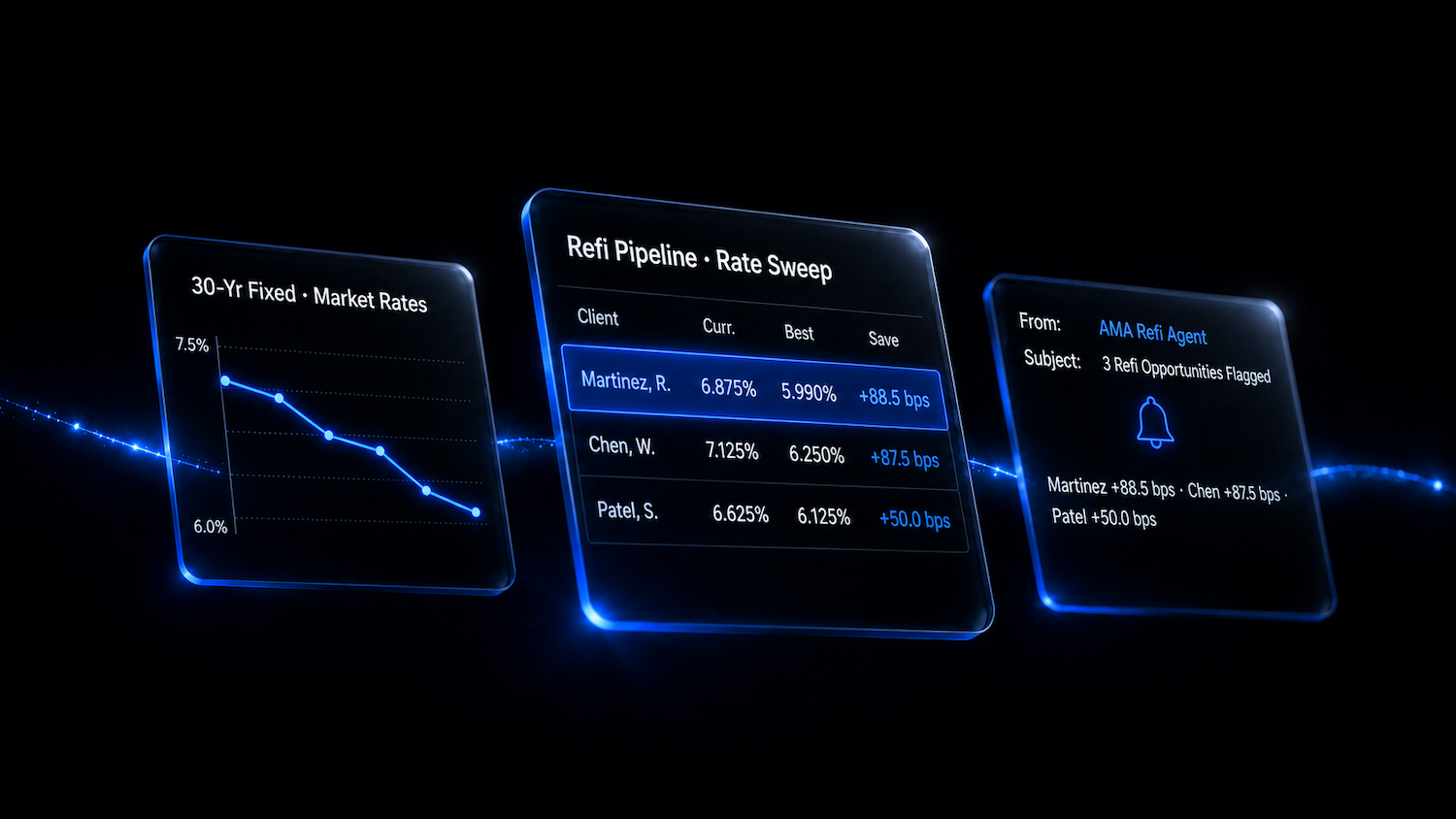
Automated refi monitoring is software that polls market rates daily and—when rates cross the threshold that could put borrowers into refi range—flags every refi-eligible past borrower whose math now works. For an independent mortgage broker, it replaces manual pipeline sweeps with always-on intelligence that closes the speed gap between you and retail lenders. Built right, it integrates with the CRM and tools you already use.
Key findings:
- The industry-average refi recapture rate was 37% in Q2 2025, while Rocket Mortgage publicly reports an 83% rate—a 2.2x asymmetry between top servicers and the rest of the market (Mortgage Bankers Association, 2025).
- OBMMI™—the Optimal Blue Mortgage Market Indices—is calculated from more than 30% of all U.S. mortgage lock transactions, updated nightly with the previous business day's lock data, and publicly viewable via Optimal Blue's website (Optimal Blue, 2025).
- According to industry reporting, roughly 70% of refi recapture opportunities are scooped up by other lenders or servicers before the original broker can act (Floify, via Mortgage News Daily, 2025).
- UWM's Mia—an automated outreach system given free to partner brokers—calls 50 past clients in 3 minutes the moment its rate-drop algorithm fires (National Mortgage Professional, 2026).
What Does Automated Refi Monitoring Actually Do for a Mortgage Broker?
Automated refi monitoring runs 3 jobs—continuously, in the background—so you don't have to. Specifically, it:
- Polls market rates daily. Pulls live mortgage pricing data, often from public benchmarks like OBMMI™ (the mortgage rate index updated nightly with the previous business day's lock data, calculated from more than 30% of U.S. mortgage lock transactions and publicly viewable via Optimal Blue's website per Optimal Blue, 2025).
- Triggers a portfolio sweep when rates move enough to matter. A daily poll is cheap; sweeping every borrower every day is wasteful. The system runs break-even math against your closed-loan list only when the day's market rate crosses the threshold that could put borrowers into refi range—daily polling, threshold-gated sweep.
- Flags borrowers who've moved into refi range. When the math says that a client's payment would drop materially—via your threshold, your break-even point—you get a notification with the borrower's name, current rate, projected new payment, and projected savings → ready to make the call.
What it replaces: weekly (or quarterly, or never) manual pipeline sweeps. What it adds: same-day awareness of opportunity. Which means the call you'd otherwise make next month—if you remembered—you make today, while the borrower is still yours.
How Is Automated Monitoring Different From Manual Pipeline Sweeps?
Manual sweeping is finite. You pull a CSV from your CRM, open this morning's rate sheets, and eyeball who might be in range. It works for ten clients. For a hundred or a thousand, it stops being a sweep and starts being a fantasy.
Automated monitoring is continuous in attention. The system polls market rates every business morning; when the day's market rate crosses the threshold that could put borrowers into refi range, it runs break-even math across your closed-loan list. The output is a short list of names you can call today—not a stack of spreadsheets to grind through next Friday.
The result of that gap is measurable. Industry reporting suggests roughly 70% of refi recapture opportunities go to other lenders or servicers before the original broker can act (Floify, via Mortgage News Daily, 2025). Speed, not skill, is usually the missing piece. Borrowers who get "rates dropped" emails Tuesday morning don't wait for your Friday sweep.
Retail lenders aren't sweeping either. UWM's Mia—the wholesale lender's automated outreach system, given free to partner brokers—calls 50 past clients in 3 minutes the moment its rate-drop algorithm fires (National Mortgage Professional, 2026). Even the best loan officer with a dedicated assistant can't match that arc by hand. The math isn't skill against skill; it's continuous against periodic.
Here's what that means for an independent broker:
- The architecture is the only thing you don't already have.
- Your CRM holds the borrower data.
- OBMMI publishes the rate data, daily.
- The break-even logic is the one your loan officers already use.
- What's missing is the system that polls daily, sweeps when the math says borrowers could be in range, and surfaces the names.
- That system doesn't require enterprise infrastructure—the same architecture, scaled to a portfolio of 200 or 2,000, runs fine for a small shop.
Per-borrower rate checks complete in roughly a second; a 50-borrower sweep finishes in about a minute, not hours. See what this looks like for an independent broker.
What Data Does a Refi-Monitoring System Need to Work?
Three inputs run the entire system:
- Your closed-loan list. Borrower contact info plus closed-loan terms (loan amount, rate, date, term, type). This typically lives in your CRM or origination system.
- A live rate feed. OBMMI is the most common starting point—it's publicly viewable, IOSCO-compliant, and covers conventional 30-year, 15-year, FHA, USDA, VA, and Jumbo, with cuts by FICO and LTV (Optimal Blue, 2025). Pricing-engine integration—Optimal Blue's PPE is the validated path—lets the system layer live qualifying rates per borrower on top of OBMMI for tighter precision. AMA scopes pricing-engine integration per engagement; non-OB PPEs (Mortech, Polly, LenderPrice) are evaluated for feasibility case-by-case.
- Your break-even logic. Which rate drop triggers a real opportunity for your borrower? Some brokers use 0.75–1.0% below the current rate as a baseline, configurable based on: closing costs, loan size, and your borrower mix.
That's the full ingredient list: Past clients, a rate feed, and your math—the system handles the rest.
What Does OBMMI Monitoring Look Like for an Independent Broker?
OBMMI publishes nightly, aggregating the previous business day's lock data. It includes 30-year conventional, 15-year conventional, FHA, USDA, VA, and Jumbo indices, plus more granular cuts by FICO and LTV (Optimal Blue, 2025). It's the same locked-rate data that informs larger lenders' pricing decisions—and it's publicly viewable on Optimal Blue's website or accessible via FRED's free data feed for non-partner integrations.
For your monitoring system, that means a daily routine:
- Daily poll. Pull the OBMMI index after the nightly publish; match each borrower to the correct index based on their loan type (a 30-year conventional borrower compares against the 30-year conventional index, not the 30-year FHA).
- Threshold-gated sweep. When the day's index movement crosses your threshold, run break-even math across your closed-loan list.
- Flag + decide. Surface flags with named borrowers, the current and new rate, and projected savings; broker decides next action (call, email, text).
Optimal Blue PPE integration is scoped per engagement; once integrated, PPE calls fire only on threshold breach, not as part of the daily poll—keeping precision-pricing call volume low. Non-OB PPEs (Mortech, Polly, LenderPrice) are evaluated for feasibility case-by-case. Without PPE integration, OBMMI alone provides the market rate signal; the system pairs it with your closed-loan data to flag borrowers in seasoning range when rates move.
For a fuller breakdown of what AI automation typically costs for a small business and how the math works against the value of saved hours, see our post on AI automation cost for small businesses.
How Fast Can an Independent Broker Get This Running?
A scoped automated refi-monitoring build typically deploys in 2–4 weeks. The variables that move that timeline:
- Portfolio size. Whether your portfolio is 50 past clients or 2,000 changes the integration approach but not the architecture. (Portfolios above 2,000 scoped at engagement entry.)
- Where your borrower data lives. Direct integrations include HubSpot, Salesforce, Airtable, Notion, and Google Sheets. Other CRMs—including Zoho, Pipedrive, and mortgage-specific systems like BNTouch, Surefire, and Total Expert—integrate via custom build scoped at engagement entry. Older or paper-based systems may need a one-time import.
- Whether pricing-engine integration is in scope. If yes, the system layers live qualifying rates per borrower on top of OBMMI for tighter precision—Optimal Blue's PPE is the validated path, scoped per engagement. Without PPE integration, OBMMI provides the market rate signal alone.
- Notification preferences. Email, text, dashboard, or all three.
What it doesn't require: technical skill on your part. At Automation Micro Agency (AMA), we build, deploy, monitor, and tune the system—you get the daily list of borrowers in refi range. For a fuller answer to "how technical do I need to be for any of this to work," see our post on whether you need to be technical to use AI automation.
Frequently Asked Questions
Do I need a pricing engine to monitor refis?
No. OBMMI is publicly viewable on Optimal Blue's website and accessible via FRED's free data feed for non-partner integrations, updated nightly with the previous business day's lock data. It's enough for baseline detection (flagging locked rates that are well above current market average); the precision flagging described above (live qualifying rate per borrower) requires pricing-engine integration, scoped per engagement. Many independent brokers start with OBMMI-only detection and add a pricing engine layer later if portfolio size justifies it.
What if my past clients are scattered across an old CRM, spreadsheets, and email folders?
That's the most common starting point. Part of the build is consolidating closed-loan data into one place the system can read—usually a single CSV or a clean import into your CRM of choice. After that, the monitoring runs against that consolidated list. For fewer than a few hundred past clients, this consolidation typically takes hours, not days.
Will the system contact my past clients automatically?
No. AMA's Refi-Alert product line defaults to human-in-the-loop: the system identifies opportunities and surfaces them to you; outreach to borrowers stays under your control. This is a deliberate architectural choice—you keep relationship judgment, compliance posture, and timing in your own hands while the system handles the watching.
Now that you've seen how the system handles rate polling, break-even math, and borrower surfacing, the next question is what that setup looks like for an independent broker with your portfolio size. We've built a page that walks through the full picture—data inputs, build cadence, ongoing tuning, and what changes for your team.
See the Broker Setup →